When the Pope and an 18-Year-Old Student Say the Same Thing at the Same Time
I have spent a lot of time arguing that ethics cannot be bolted onto technology after the fact. It has to be designed in from the start. This past week gave us two very loud reminders of what happens when it is not.
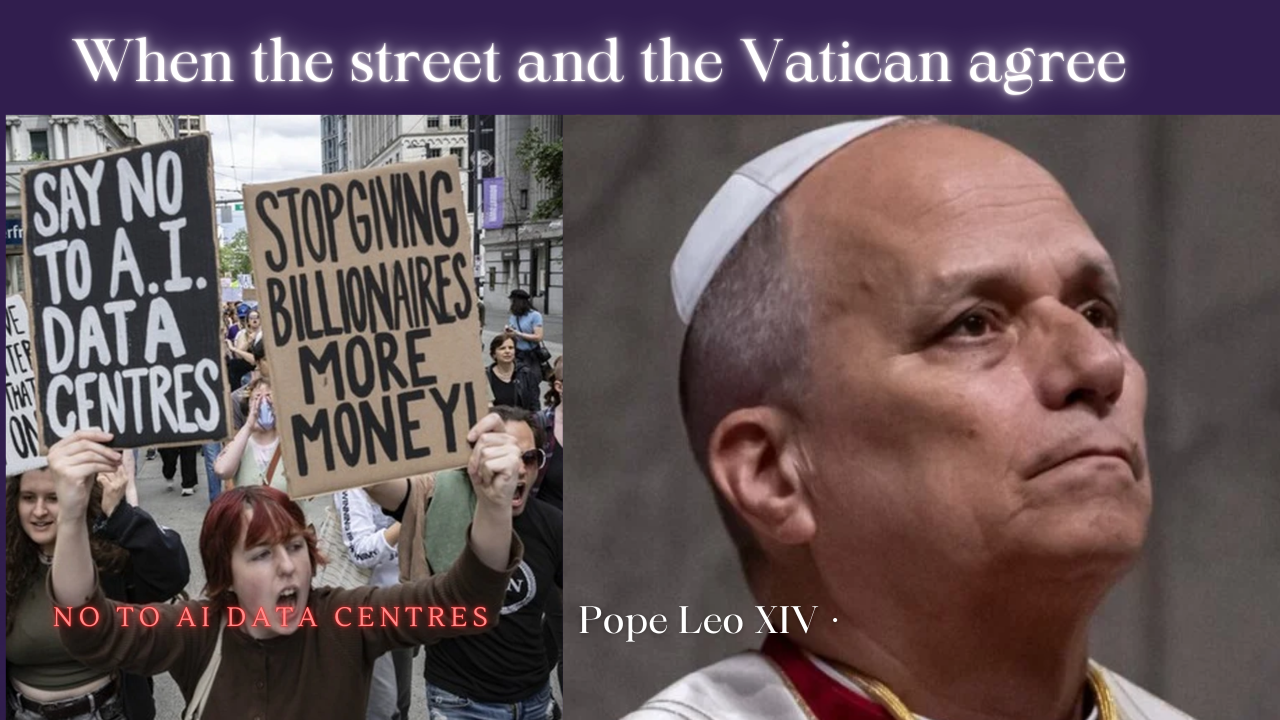
On May 23, an 18-year-old university student named Torin LaRocque organized a protest march through downtown Vancouver. LaRocque had almost no experience organizing protests. It was put together in about a week. More than 500 people showed up, chanting "use your brain" as they crossed the Granville Bridge to Granville Island, then marched on to City Hall. A second march is already planned for June.
On May 25, Pope Leo XIV released Magnifica Humanitas, his first encyclical. It is the most comprehensive moral reckoning with artificial intelligence ever issued by a major world institution. He called for AI to be "disarmed," meaning freed from the logic of military competition, corporate arms races, and concentrated financial power. He deliberately signed it on May 15, the 135th anniversary of Rerum Novarum, the landmark 1891 document that forced the world to reckon with the human cost of the Industrial Revolution.
Two very different voices. The same diagnosis.
What Vancouver Is Actually About
Telus, in partnership with the federal government and developer Westbank, announced in May that it is building a cluster of AI data centres in British Columbia. Two facilities are planned for Vancouver. The first will convert the former Hootsuite building in Mount Pleasant and come online later this year. A second 10-storey centre at 150 West Georgia Street is planned for 2029. A third facility in Kamloops is also part of the project. Together, the network is projected to scale to more than 60,000 GPUs and 150 megawatts of computing capacity by 2032.
Telus says the centres will run on 98 percent renewable electricity from BC Hydro and use a closed-loop cooling system that reduces water consumption by up to 80 percent compared to a standard data centre. Mayor Ken Sim has called them "world-class facilities."
The protesters are not disputing the engineering. They are raising something harder to quantify.
Torin LaRocque put it plainly at City Hall after the march. Vancouver is already under Stage 2 water restrictions. Even with an 80 percent reduction in water use, 60,000 GPUs processing AI prompts at scale consume a significant volume of water every single day in a city that is already rationing it. BC Green Party leader Emily Lowan spoke at the rally. Vancouver City Councillor Sean Orr marched with the crowd. This is not a fringe concern.
The signs the protesters carried said as much. One read: "Do you want a world run on hallucinations?" Another criticized AI slop. These are not technophobes. They are people asking a specific question: who decided this was acceptable, and when did anyone ask us?
What the Pope Is Actually Saying
It is worth being precise here, because Magnifica Humanitas is being discussed mostly in terms of its most dramatic phrase. "Disarming AI" does not mean dismantling it. The encyclical is explicit that technology is not inherently evil and is not a force antagonistic to humanity.
What it says is this: technology is never neutral, because it takes on the characteristics of those who devise, finance, regulate, and use it.
That is not theology. That is systems design.
The encyclical makes several arguments that belong in every serious governance conversation. Leo writes that AI frequently forces workers to adapt to the speed and demands of machines, rather than machines being designed to support the people who work. If you have watched algorithmic performance management roll through logistics, content moderation, or customer service, you know exactly what he means.
The encyclical also addresses subsidiarity and the concentration of power, arguing that decisions affecting communities should not be made at distances that remove accountability from those most affected.
A further argument concerns the gap between what AI promises and what it delivers for most people. The promise is liberation from drudgery, better public services, scientific breakthroughs. The reality so far is that much of the efficiency gain has flowed to a very small number of companies and investors, while the costs, algorithmic management, misinformation, environmental pressure, disrupted labour markets, have been distributed broadly. That gap is not inevitable. It is the result of specific choices about who benefits and who absorbs the disruption.
What Needs to Change
Ethics by design means building accountability into the process before the concrete is poured, not issuing a statement after 500 people show up at City Hall.
Mandatory community consultation before major AI infrastructure is approved. Not a comment period that opens after the decision is already made. Genuine participation, with real ability to shape outcomes, from the communities that will live with the consequences.
Independent environmental impact assessments for large-scale AI infrastructure with enforceable standards, not industry self-reporting against voluntary targets.
Labour protections built for the reality of algorithmic management, not retrofitted from frameworks designed for a factory economy.
International governance with real teeth. The Pope is right that no single government, company, or institution can solve this alone. The competitive logic driving AI development will not be interrupted by any one player choosing to slow down unilaterally. It requires a coordinated structure, the way financial systems require coordinated regulation.
A genuine commitment from the technology industry to treat democratic legitimacy as a design constraint, not a communications problem. The fact that Torin LaRocque, at 18, with no organizing experience, could generate a march of 500 people in a week should tell us something about the level of public trust the industry currently holds.
The Moment We Are In
I do not think it is a coincidence that a first-year Pope from Chicago and a university student in Vancouver arrived at the same conclusion in the same week. Both are responding to something real: a growing recognition that the people most affected by AI are being asked to accept decisions they were never invited to make.
You do not have to be Catholic to take the encyclical seriously. You do not have to be opposed to data centres to take the Vancouver protest seriously. What the moment requires is honesty about the fact that the current model, fast deployment, managed optics, post-hoc governance, is not working.
The protests are going to keep coming. The moral arguments are going to keep getting louder. The question is whether the industry, and the governments partnering with it, will meet that moment with genuine accountability or with better communications strategies.
I know which one I am building toward.
Maysa Hawwash, Founder and CEO, ScaleX
Maysa Hawwash
Founder & CEO, ScaleX
HR strategist and author of the Ethics by Design newsletter, helping organizations grow with integrity.
More in AI Governance
June 9, 2026
When Good Intentions Aren't Enough: The Governance Gap in Humanitarian AI
The humanitarian sector is deploying AI faster than it is building the governance to match. When the population you serve is in crisis, displaced, and undocumented, that lag is not a footnote. It is a failure.

May 12, 2026
1.1 billion
On Workday, the EU AI Act, and the five things HR leaders need to do before August 2. The number is 1.1 billion: that's how many job applications Workday's court filings admit its software has rejected since September 2020.

February 19, 2026
Ethics Is Not a Principle. It's an Architecture.
Every organization deploying AI today is quietly redesigning its moral system, not through mission statements, but through workflows.