When Good Intentions Aren't Enough: The Governance Gap in Humanitarian AI
There is a version of this conversation that goes: artificial intelligence can process more beneficiary data, flag more needs, route more referrals, and do it faster than any human team. That part is probably true. It is also not the point.
The humanitarian sector is moving toward AI-assisted programming in a way that looks, from the outside, like thoughtful innovation. Needs assessment tools. Cash assistance targeting algorithms. Predictive displacement models. The language is careful. The intentions are real. But the governance frameworks are almost universally lagging behind the procurement timelines, and in humanitarian contexts, that lag has consequences that do not show up in a product demo.
The populations humanitarian organizations serve are not the populations AI systems were built for. They are people in crisis: displaced, traumatized, often undocumented, frequently multilingual, with fragmented or nonexistent digital histories. The AI systems being deployed in humanitarian response were largely trained on data generated by people who are none of those things. That gap does not close because a vendor has a humanitarian use case slide.
When a targeting algorithm underweights a family because their profile does not match the training distribution, the result is a family that does not receive food. That asymmetry is not a technical limitation to be disclosed in a footnote. It is a governance failure that has to be addressed before deployment, not after an incident review.
Consent in a Transit Camp Is Not the Same as Consent in a Product Flow
Meaningful consent requires that a person understands what they are agreeing to, believes they have a real choice, and has a viable way to revoke that agreement later. In a registration tent, at 2 a.m., with a family who has been walking for four days and needs to access services by morning, none of those conditions are straightforward. The question is whether organizations are designing for the actual condition or for the compliance checkbox.
The humanitarian sector has done serious work on data protection. The ICRC's data protection handbook. OCHA's responsible data principles. There is no shortage of frameworks. What is missing is honest organizational reckoning with what those frameworks require in practice.
The Accountability Chain Runs in the Wrong Direction
In a typical humanitarian AI deployment, the accountability structure runs from donor to implementing organization to technology vendor to beneficiary. The person most affected is at the end of that chain, with the least power, the least visibility, and the least ability to challenge what the system decided about them.
That is the default architecture of every institutional technology deployment, not a design flaw that happened accidentally, and humanitarian organizations have to actively build against it. What does a grievance mechanism look like for someone who does not speak the interface language, has no device, and has no legal status in the country they are in? That is the question to answer before signing a vendor contract. It is almost never asked.
The Gaza Humanitarian Foundation
We do not need to imagine what this failure looks like at scale. We have a recent case study.
The Gaza Humanitarian Foundation was established as a parallel distribution system, with AI-assisted logistics, in one of the most surveilled and controlled environments on earth. UN Special Rapporteur Francesca Albanese put it plainly: a profit-driven parallel system involving companies already linked to unlawful conduct can only be regarded as a monstrosity.
The essential ingredients for humanitarian assistance are not trucks and logistics capacity. They are the trust of communities, a deep understanding of how crisis shapes what people do and need, a commitment to keeping people safe and treating them with dignity, and an uncompromising refusal to be instrumentalized for political or military agendas. The GHF had none of those things. Its AI infrastructure made the accountability gap harder to see, not easier to close.
Speed Is Not the Same as Impact
There is pressure in humanitarian operations, as in every sector, to demonstrate scale. Donors want numbers. Boards want efficiency metrics. AI offers both. Process more referrals. Serve more people. Show the graph going up.
Efficiency is an instrument, not a value. A system that processes three times as many referrals but sends a meaningful percentage of people to services they cannot access, that cannot account for the complexity of their situation, that flags them as ineligible based on criteria they never had a chance to contest, is not better than a slower system that gets it right. It is faster at the wrong thing.
Organizations under real resource pressure need to resist the conflation of volume and value. The pressure is highest where the stakes are highest.
The Sequence and the Architecture
This is not an argument against AI in humanitarian response. There are genuine use cases. Predictive analytics that gives a logistics team 48 hours of warning before a border crossing becomes impassable. Translation infrastructure that breaks down language barriers in intake. Pattern recognition in health data that flags outbreaks before they spread. The technology is not the problem.
The problem is the sequence and the architecture. Most organizations are running it backwards: identify the tool, secure the funding, deploy, then figure out the governance. Ethics by design means the governance comes first. The accountability structure is built before the contract is signed. The consent process is designed for the actual population before the data collection begins. The grievance mechanism exists before the system makes its first determination.
That sequence is harder, and it takes longer. It sometimes means saying no. For organizations whose legitimacy rests on being present in the worst conditions humans face, it is not a higher standard. It is the minimum one.
The people the humanitarian sector serves are not a use case. They are the reason the sector exists. AI deployment that treats them as anything less is not innovation. It is a governance failure with a better interface.
The GHF is closed. The Palantir contract is not. I have spent years arguing that ethics cannot be bolted on after the fact. The humanitarian sector is running out of time to test that argument. The tools are already deployed. The vendors are already embedded. The governance frameworks are already behind. What happens next depends on whether organizations treat that gap as a communications problem or a design failure. Only one of those answers is honest. And only one of them protects the people this work is supposed to be for.
Maysa Hawwash, Founder and CEO, ScaleX

Maysa Hawwash
Founder & CEO, ScaleX
HR strategist and author of the Ethics by Design newsletter, helping organizations grow with integrity.
Put these ideas into practice
More in AI Governance
May 28, 2026
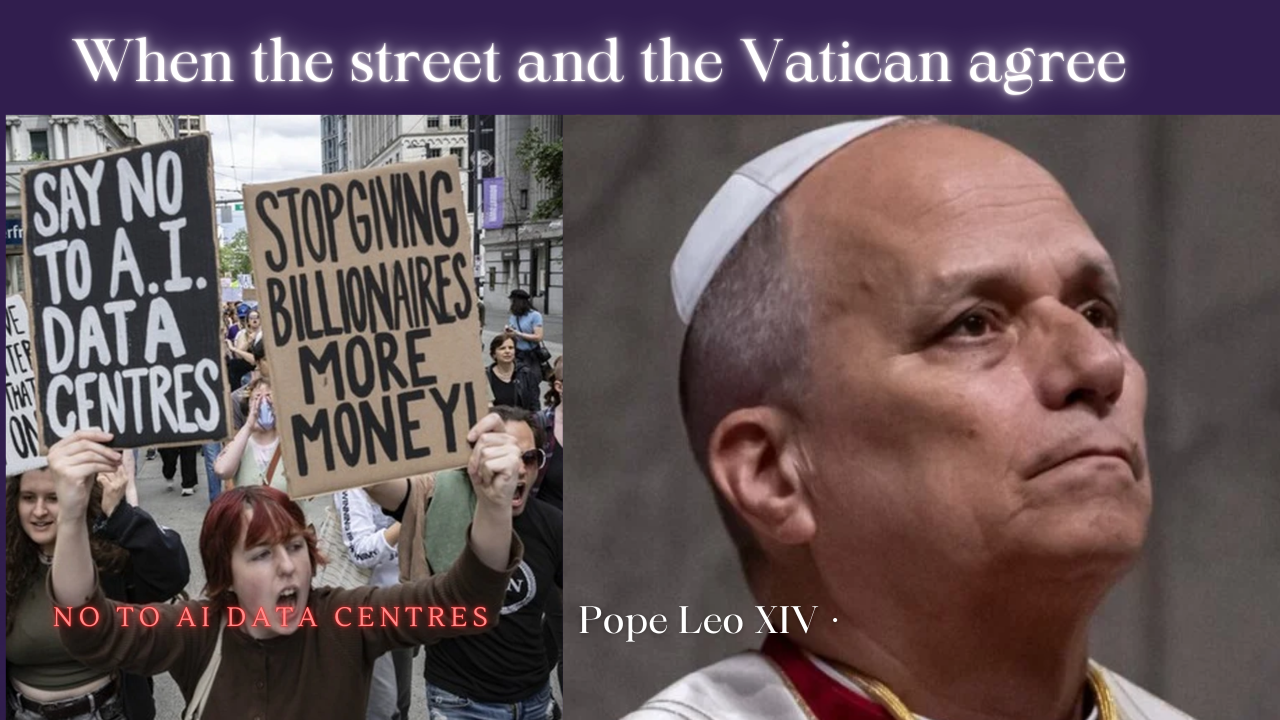
When the Pope and an 18-Year-Old Student Say the Same Thing at the Same Time
A university student in Vancouver and the Pope of the Catholic Church arrived at the same diagnosis of artificial intelligence in the same week. That is not a coincidence. It is a signal.

May 12, 2026
1.1 billion
On Workday, the EU AI Act, and the five things HR leaders need to do before August 2. The number is 1.1 billion: that's how many job applications Workday's court filings admit its software has rejected since September 2020.

February 19, 2026
Ethics Is Not a Principle. It's an Architecture.
Every organization deploying AI today is quietly redesigning its moral system, not through mission statements, but through workflows.