
The Bill Always Arrives: What Capital Owes Ethics by Design
We've all seen it. The foundation name on the vaccine box. The donor wall in the hospital lobby. The gala photo with the giant cheque. We were taught that generosity at scale is its own credential. That if someone gives away billions, the giving settles the question of who they are.
This week the question reopened.
Warren Buffett excluded the Gates Foundation from his midyear donations for the first time in twenty years. Nearly six billion dollars in Berkshire shares went instead to four foundations run by his children. The reporting is careful about why. Buffett is waiting on the results of an external review into the foundation's ties to Jeffrey Epstein, a review launched only after emails in the Epstein files showed the financier in contact with foundation staff. Melinda French Gates had already departed the foundation she co-founded, and the association she could not outlast followed her out.
Sit with that for a moment. Not the scandal. The mechanism.
For two decades, the Gates Foundation functioned as the gold standard of reputational cover. Association with it conferred legitimacy. Grants from it silenced critics. Its brand was so strong that it operated as a kind of ethical firewall, absorbing scrutiny that might otherwise have reached the people and money behind it.
The firewall failed. Not because activists finally shouted loud enough. Because the ledger caught up.
The Washing Has a Shelf Life
Here is what I keep telling clients, and what this moment proves. Philanthropy washing is not a permanent structure. It is a delay tactic.
Reputation is a lagging indicator. It reflects what an institution was, not what it is. You can run image ahead of substance for years. Sometimes decades. But the gap between what an organization funds publicly and what it tolerates privately does not close on its own. It compounds. And when it surfaces, it surfaces all at once, with interest.
Notice the order of who moved. Regular people moved first. Survivors who refused to stay quiet. Journalists who kept pulling threads nobody wanted pulled. Ordinary people who said enough, and kept saying it when it was inconvenient to hear. They built the pressure for years while institutions looked away. Buffett moved last. His pause is not moral heroism. It is risk management. And that is precisely the point. Capital is always the last to act. It only acts when the reputational cost of staying exceeds the cost of moving.
You cannot fool the world forever. The world keeps receipts. It just takes its time reading them.
What Ethics by Design Asks of Capital
I write about ethics by design as an operating principle for organizations. But it binds capital too. Investors and philanthropists are not neutral pipes. Where money sits is an ethical position. Where it stays silent is an ethical position. Buffett's twenty years of annual gifts were an endorsement, renewed annually, whether he framed them that way or not.
So if you allocate capital, to companies or to causes, here is what ethics by design asks you to look for before the headlines do it for you.
One. Governance that binds the founder. Ask who can say no to the person whose name is on the building. If the answer is nobody, you are not funding an institution. You are funding a person, with all the concentration risk that carries. A board that cannot constrain its founder is decoration.
Two. Mechanisms that predate the crisis. An external review launched after the emails surface is remediation, not governance. Ethics by design means the vetting of relationships, donors, and intermediaries exists before anything goes wrong. When you diligence an organization, ask to see the controls that were built in quiet years. That is where the truth lives.
Three. Transparency about proximity. Who does the institution associate with, and who does it protect? Reputational laundering runs in both directions. Institutions lend cover to individuals, and individuals buy legitimacy through institutions. Map the associations, not just the grants.
Four. Decision rights for the people affected. This is the thread that runs through everything I write. An organization that speaks about communities but gives them no power over decisions is performing accountability, not practicing it. Testimonial roles are not governance. Look at who votes, not who is photographed.
Five. Incentives that survive inconvenience. Buffett has said he wants his money spent on current needs rather than parked in endowments. Whatever else you think of him, that is a structural choice. It forces urgency and reduces the empire-building that turns foundations into reputation machines. Ask whether the giving structure serves the mission or the image of the giver. The architecture will tell you.
Six. Exit discipline. The hardest one. Capital that leaves when values are breached, and says why, does more for accountability than a hundred ethics statements. Silent divestment protects the divestor. Public reasoning protects everyone else. Buffett's pause made headlines because he let it be visible. That visibility is the accountability.
The Lesson Underneath
None of this is really about Gates or Buffett. It is about the belief, still dominant in boardrooms and family offices, that generosity is a substitute for governance. It is not. Giving is an output. Ethics is an architecture. You can have extraordinary outputs running on rotten architecture for a long time. Then one Tuesday in July, twenty years of standing arrangements end in a press statement, and everyone who lent their credibility along the way has to answer for it.
Build the architecture first. Fund the architecture first. Because the alternative is what we watched this week. The bill always arrives. The only choice you get is whether you designed for the day it does.
Maysa Hawwash, Founder and CEO, ScaleX
Maysa Hawwash
Founder & CEO, ScaleX
HR strategist and author of the Ethics by Design newsletter, helping organizations grow with integrity.
Put these ideas into practice
More in Ethics by Design

August 4, 2026
Should You Comply With a Profile Verification Request?
Platforms are asking you to verify your identity. A badge appears next to your name. It looks like a small thing. It is not a small thing. It is a data collection event dressed as a trust feature, and almost no one asks the governance question before agreeing to it.

July 22, 2026
The Chart and the Layoff, Same Week
Xbox cut 3,200 jobs the same week Microsoft was celebrating record AI investment. The memo was unusually candid. What it got backward was the order. Sequencing choices are design choices, whether anyone treats them that way or not.
April 25, 2026
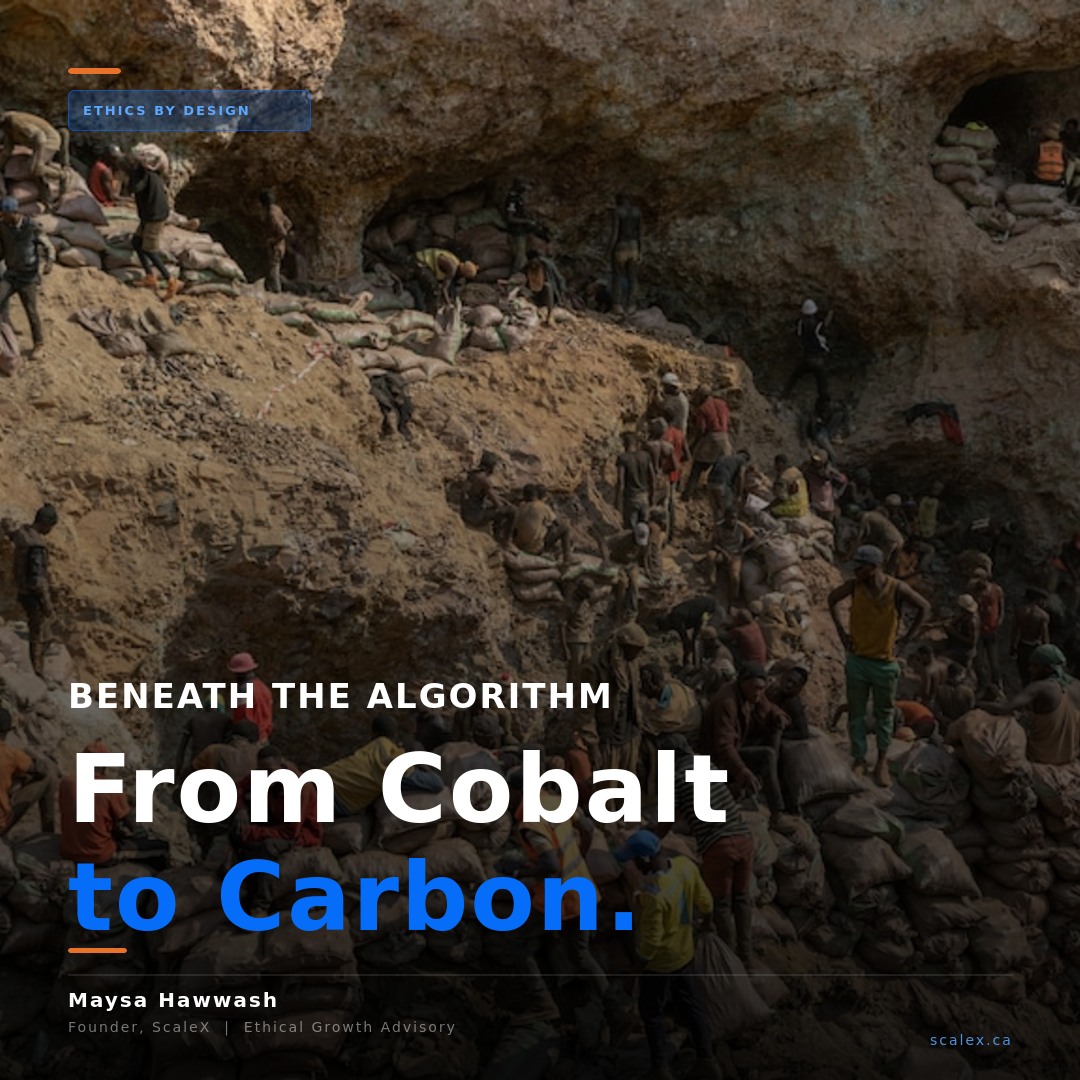
Beneath the Algorithm: From Cobalt to Carbon
The real ethical crisis in AI is not just in the code. It is in the ecosystem. The data center humming in Arizona is connected to the cobalt mine in the Congo, the e-waste landfill in Ghana, and the rising water table in Taiwan.