Beneath the Algorithm: From Cobalt to Carbon
As I sat down to prepare for participating in a panel on AI ethics, I kept feeling that something was missing. By only focusing on the algorithm, decision making and power dynamics may be foundational to AI ethics, but that is only the tip of the iceberg.
The real ethical crisis in AI is not just in the code. It is in the ecosystem.
Infrastructure is one dimension. But the full picture extends further: a whole new world system of extraction, production, and disposal that reshapes how societies interact with resources, labor, and each other. The data center humming in Arizona is connected to the cobalt mine in the Congo, the e-waste landfill in Ghana, and the rising water table in Taiwan. AI ethics that stops at the algorithm misses these threads entirely.
If we are serious about ethics by design, we need to look beneath the algorithm, and beyond it.
The Resource Ecosystem
AI does not run on software alone. It runs on a planetary network of extraction and consumption.
1. Energy. Training a single large language model can consume as much electricity as 120 US homes over five years. US data centers now devour 4.4% of national electricity, up from 1.9% in 2018, with projections hitting 6.7% to 12.0% by 2028. This energy demand reshapes grid priorities, often locking in fossil fuel dependency when communities need transition most.
2. Water. A single AI query evaporates roughly 10 to 25ml of clean water, with 20 to 50 queries equating to a 500ml bottle. Large data centers can drain 5 million gallons daily, the equivalent of a town of 10,000 to 50,000 people. Morgan Stanley projects AI-related data centers could consume more than 1 trillion liters annually by 2028. In water-scarce regions, this creates direct competition between AI infrastructure and human needs.
3. Manufacturing. The semiconductor industry generates significant CO2 emissions, with more than 80% coming from electricity consumption during manufacturing and device use. A single chip requires 2.1 to 2.6 gallons of water for cooling and manufacturing. The fabrication plants concentrated in Taiwan, South Korea, and China create geopolitical chokepoints and environmental sacrifice zones that ripple through global supply chains.
4. E-waste. Specialized AI accelerators become obsolete in 2 to 3 years, creating toxic waste streams that disproportionately impact marginalized communities near disposal sites. This is not just pollution. It is a reorganization of labor and health risk onto populations with the least political power to resist.
The Colonial Extraction Ecosystem
The AI ecosystem does not just mirror historical extraction patterns. It extends them into new domains.
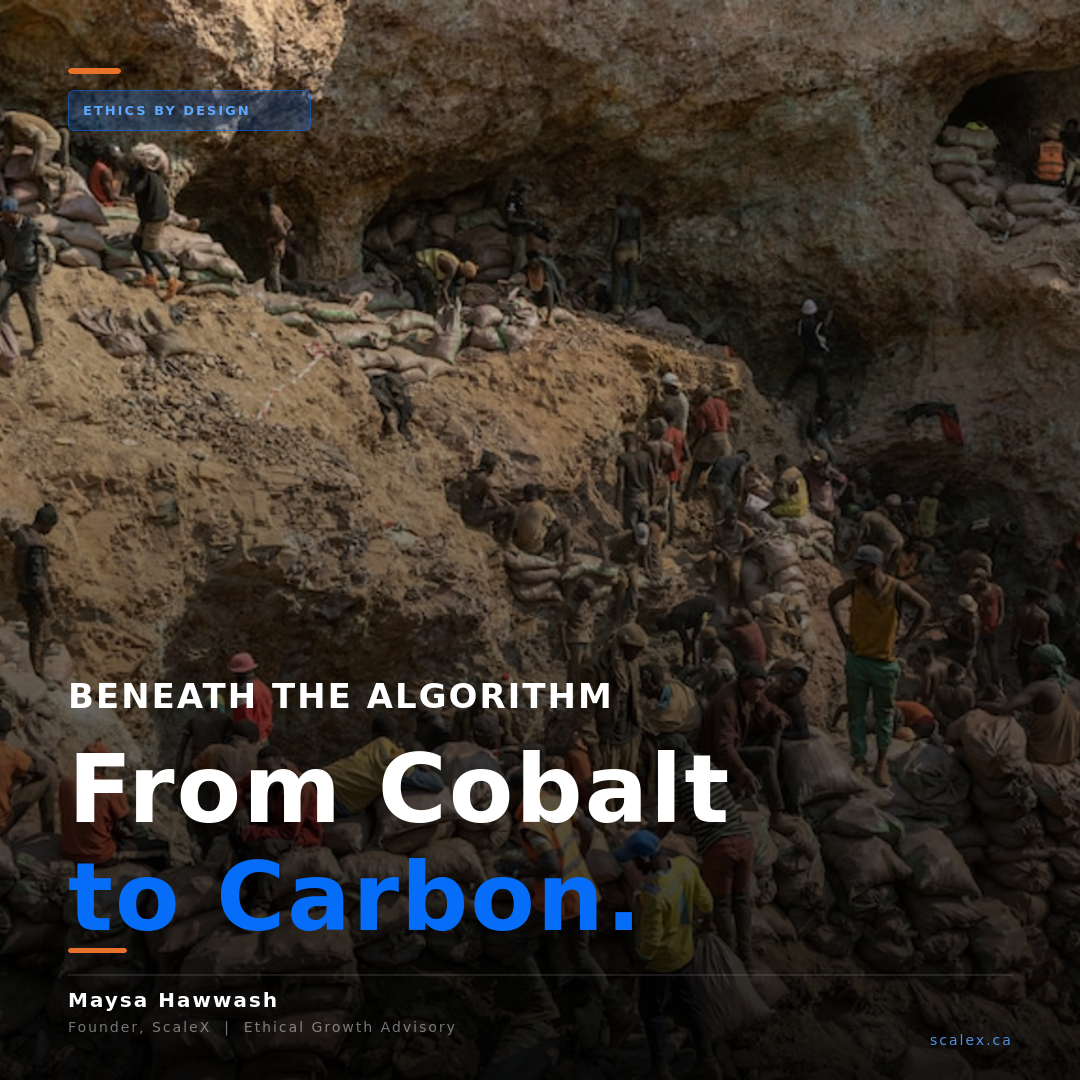
Resource colonialism. The Democratic Republic of Congo supplies over 70% of the world's cobalt, yet sees minimal benefit from the AI economy it enables. Rare earth elements are mined in the Global South, often under exploitative conditions, to fuel AI development in the Global North. The smartphone in your pocket and the server in the data center both carry this supply chain in their silicon.
We are told AI makes systems more efficient. But efficiency often masks increased total consumption, and systemic transformation.
The rebound effect. AI-optimized logistics reduce per-package emissions while dramatically increasing total shipping volumes. AI-driven recommendations improve targeting but increase overall consumption. The system adapts to absorb every efficiency gain, growing rather than stabilizing.
The scaling arms race. Each new model demands more resources than the last. Progress is measured by model size, not usefulness. This arms race does not just consume resources. It concentrates power in the hands of those who can afford to compete.
The opacity problem. True environmental costs are buried behind corporate greenwashing and complex supply chains. Companies rarely disclose the full lifecycle impacts of their AI products. This opacity is not accidental. It is structural, enabled by global supply chains that fragment accountability across jurisdictions and corporate entities.
Environmental Impact Data
The scale of AI's environmental footprint is staggering, and still undercounted.
- Energy consumption: US data centers now consume about 4.4% of electricity nationwide, up from 1.9% in 2018, with projections reaching 6.7% to 12.0% by 2028.
- Training costs: Training GPT-3 alone consumed 1,287 megawatt-hours of electricity, enough to power 120 US homes for a year, and generated 552 tons of CO2.
- Query impact: Each AI query uses 10 to 25ml of water, with 20 to 50 queries equating to a 500ml bottle.
- GPU boom: 3.85 million GPUs shipped to data centers in 2023, up from 2.67 million in 2022.
What Ethics by Design Can Look Like
If we applied ethical design principles to the full AI ecosystem, we would see transformation across multiple dimensions.
Resource-conscious architecture. Designing systems that minimize computational requirements, prioritize efficiency over scale, and consider the full lifecycle impact. This means questioning whether every use case requires a large language model, and whether smaller, specialized systems might serve human needs better.
Distributed infrastructure. Moving away from massive centralized data centers toward distributed computing that utilizes existing infrastructure and reduces resource concentration. This also means distributing the economic benefits of AI more equitably across the network.
Circular design. Building AI systems with repairability, upgradeability, and responsible disposal in mind, rather than planned obsolescence. The 2 to 3 year accelerator lifespan is a design choice, not a physical law.
Community-centered development. Involving affected communities in design and deployment decisions means the communities near mines, fabs, data centers, and landfills have seats at the design table, not as consultation boxes to check, but as decision-makers with veto power. It means AI development serves local needs rather than extracting from them. This is not a technical fix. It is a power shift.
Transparency requirements. Mandating comprehensive disclosure of resource usage, including energy, water, and material costs throughout the AI lifecycle. Not just corporate sustainability reports, but accessible, auditable public data.
Signs of Potential: What Regenerative AI Could Look Like
No one has fully solved this yet. But there are signals that AI can operate within, and possibly regenerate, the ecosystems it depends on.
Radical energy efficiency. Using smaller, specialized models rather than massive general-purpose systems can dramatically cut per-query energy consumption. The assumption that bigger is better is a design choice, not a law of nature.
100% renewable energy. Data centers powered by stranded renewable energy, wind and solar in remote locations, can eliminate fossil fuel dependency. This shifts the locational logic of the internet, potentially democratizing geographic access to digital infrastructure.
Heat recycling innovation. Data centers in Nordic countries and elsewhere are pioneering heat export systems that convert waste heat into district heating for local communities. This turns a waste stream into a community resource, reimagining the data center as civic infrastructure rather than isolated consumption node.
Carbon offset programs. When efficiency and renewables are not enough, investing in verified offset projects that exceed operational footprint can achieve net-negative emissions. The key word is verified, and the standard must be high enough to mean something.
Thaura.ai is one company making these principles central to its model. It claims to use GLM-4.5 Air with 12 billion active parameters, compared to 3 to 5 trillion in larger systems, resulting in 94% less energy consumption per query, 100% renewable energy infrastructure, heat recycling systems, and carbon offset investments that exceed its operational footprint.
Policy and Systemic Accountability
The AI industry faces increasing regulatory pressure, but regulation alone will not restructure an ecosystem.
The US AI Foundation Model Transparency Act, introduced in March 2026, requires disclosure of computational power used in training. It does not require reporting carbon emissions, water usage, or supply chain impacts. Open-source models are exempt. It is a transparency measure with no environmental teeth.
The EU AI Act requires energy consumption disclosure for general-purpose AI, but includes a major loophole: providers can claim they lack "critical information from compute or hardware provider" and skip disclosure entirely. The standards are voluntary, not binding. Environmental documentation is restricted to authorities, not public. There is no continuous monitoring, no standardized measurement methodology, and embodied emissions from hardware manufacturing are entirely omitted.
A Cornell University study published in Nature Sustainability found that smarter siting, faster grid decarbonization, and operational efficiency could cut AI's carbon impact by approximately 73% and water impact by 86%. The roadmap is technically sound. Whether policy and market incentives will follow it is an open question.
Current regulations treat symptoms. The disease is the business model.
The Real Question
We cannot have ethical AI built on an unethical ecosystem of extraction and exploitation.
The challenge is not just making algorithms fairer. It is redesigning the entire system, the mines, the fabs, the data centers, the grids, the waste streams, the labor markets, the governance structures, to operate within planetary boundaries and serve human needs rather than extracting from them.
Global justice. Recognizing that AI ethics cannot be divorced from questions of global equity and environmental justice. The ecosystem does not respect borders. Neither should our ethical frameworks.
What is your organization's approach to ecosystem ethics? Are you measuring the full network impact of your AI systems, or just the algorithmic outputs?

Maysa Hawwash
Founder & CEO, ScaleX
HR strategist and author of the Ethics by Design newsletter, helping organizations grow with integrity.
More in Ethics by Design

August 4, 2026
Should You Comply With a Profile Verification Request?
Platforms are asking you to verify your identity. A badge appears next to your name. It looks like a small thing. It is not a small thing. It is a data collection event dressed as a trust feature, and almost no one asks the governance question before agreeing to it.

July 22, 2026
The Chart and the Layoff, Same Week
Xbox cut 3,200 jobs the same week Microsoft was celebrating record AI investment. The memo was unusually candid. What it got backward was the order. Sequencing choices are design choices, whether anyone treats them that way or not.

July 14, 2026
The Bill Always Arrives: What Capital Owes Ethics by Design
Warren Buffett redirected six billion dollars away from the Gates Foundation this week. The lesson is not about scandal. It is about the gap between philanthropic reputation and actual governance, and why that gap always closes eventually.